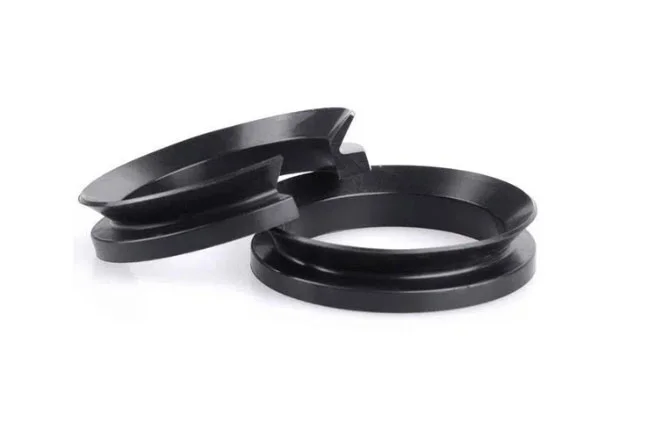
What Is a V-Ring?
All-rubber V-rings are designed for rotary shaft applications across a wide range of industries.
They can be used as standalone seals to retain lubricants and protect bearings from contamination, or as auxiliary seals to protect primary seals in heavily polluted environments.
A V-ring is mounted directly onto the shaft. Its thin, flexible conical lip seals axially against a stationary counterface perpendicular to the shaft. Because the V-ring rotates together with the shaft and acts like a flinger, it effectively repels dirt, water, and other contaminants.
Even under shaft eccentricity, misalignment, or axial movement, V-rings continue to provide reliable sealing performance.
How a V-Ring Works
-
The V-ring is installed with an interference fit on the shaft and rotates together with it.
-
The elastic sealing lip makes axial contact with a stationary counterface.
-
Axial shaft movement is absorbed by the flexibility of the sealing lip and hinge area.
-
The design allows angular misalignment and compensates for shaft runout or eccentric rotation.
Because V-rings are made entirely of elastomer—with no metal case or fabric reinforcement—they are extremely easy to install. Depending on size, they can be stretched and passed over flanges, pulleys, or housings, which is especially valuable during seal replacement.
Key Design Features
A V-ring consists of:
-
A flexible sealing body
-
An elastic conical sealing lip
-
An integrated elastic “hinge”
The internal tension of the elastomer keeps the seal firmly positioned on the shaft. The sealing lip applies low contact pressure to the counterface—sufficient to seal, yet low enough to minimize friction, heat generation, and wear.
In some low-speed applications, V-rings can even operate under dry-running conditions with very low torque.
As shaft speed increases, centrifugal force reduces lip contact pressure. This keeps friction losses and heat build-up at a minimum, significantly extending service life.
At approximately 12 m/s (2360 ft/min), power loss reaches its maximum. Beyond this speed, power loss decreases, and at around 20 m/s (3900 ft/min), the sealing lip lifts completely and the V-ring functions as a non-contact gap seal and deflector.
Materials
-
NBR (Nitrile Rubber):
Standard material with good chemical resistance and wear performance for normal operating temperatures. -
FKM (Fluoro Rubber / Viton®):
Recommended for higher temperatures or aggressive chemical environments.
In product tables, material identification is usually marked as:
-
R = NBR
-
V = FKM
Safety Warning
When exposed to temperatures above 300 °C (570 °F), all FKM and PTFE-based materials may release hazardous fumes—for example during welding operations when removing bearings.
If a seal has been exposed to such temperatures:
-
Always wear protective gloves and safety glasses
-
Place seal residues in a sealed container marked “corrosive material”
-
Wash skin thoroughly with soap and water after contact
-
Rinse eyes with plenty of water if exposed and seek medical attention
-
Seek medical advice if fumes are inhaled
Material Safety Data Sheets (MSDS) are available upon request.
Standard V-Ring Designs
-
VR1 / VA
Standard cross-section with straight sides. Commonly used in gearboxes, motors, and general transmission applications. -
VR2 / VS
Smaller cross-section with tapered sides and a wider body for improved shaft retention. Typical for agricultural and automotive applications. -
VR3 / VL
Extremely compact axial design. Ideal where installation space is limited and as a replacement for labyrinth seals. -
VR4 / VE
Heavy-duty auxiliary seal for severe contamination. Largest cross-section and highest axial displacement capability. Diameter range: 300–2010 mm. -
VR6 / VRME
Heavy-duty large-diameter V-rings for applications with significant axial movement. Fixed axially and radially using clamping bands. Typically custom-made for steel mills, paper mills, and large industrial equipment.
When shaft diameter falls between two sizes, always select the larger V-ring.
Special designs—including split V-rings—are available upon request.
Main Functions of V-Rings
-
Suitable for both grease-lubricated and oil-lubricated applications
-
For grease-lubricated bearings, V-rings are typically installed outside the bearing housing to expel dust, water spray, and contaminants
-
Can function as a grease valve, allowing excess or used grease to escape
-
For oil sealing, the V-ring must be axially fixed and positioned on the lubricant side
-
V-rings should not be fully submerged in the application medium
Additional Applications
-
Auxiliary seals protecting primary seals and counterfaces
-
Enhancing the sealing performance of labyrinth seals
-
Preventing corrosion and contamination in harsh environments
Installation Guidelines
-
Clean the V-ring, shaft, and counterface thoroughly
-
Ensure the shaft is dry and free of oil before installation
-
Lightly lubricate the sealing lip with grease or silicone oil
-
Do not apply grease to the counterface unless friction reduction is required
-
Ensure uniform stretching and correct positioning around the shaft
Thanks to their elasticity, V-rings can be stretched over components and installed quickly, even in the field.