
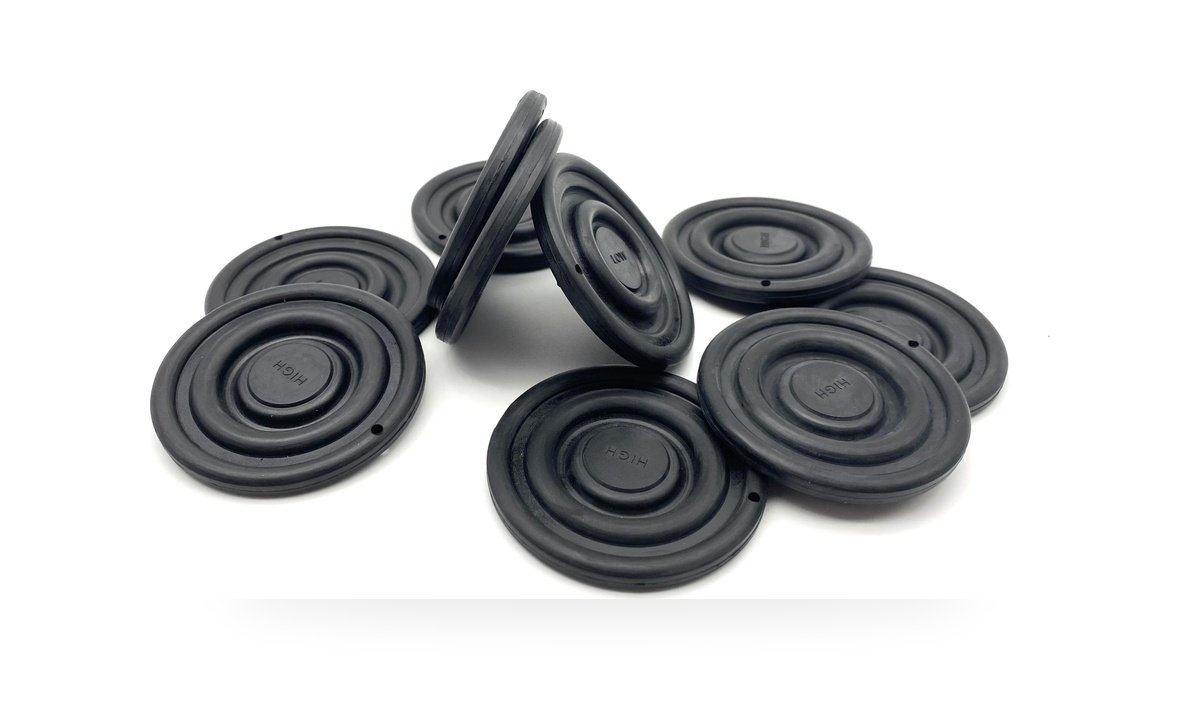
Rubber diaphragms are critical sealing and flexing components used in pumps, valves, dosing systems, regulators, actuators, and industrial fluid control equipment. They help separate media, transfer pressure, support repeated movement, and reduce leakage risk in demanding working conditions.
Unlike simple flat rubber parts, diaphragms often need to handle repeated flexing, pressure changes, chemical exposure, temperature variation, and installation stress. A suitable diaphragm depends on the material, reinforcement structure, shape, thickness, mounting design, and the actual working environment.
O.S Seals supplies custom rubber diaphragms, pump diaphragms, valve diaphragms, fabric reinforced diaphragms, and PTFE bonded rubber diaphragms for industrial B2B customers. We can support projects based on drawings, samples, photos, dimensions, material requirements, or application information.
Product Types
– Rubber Diaphragms
– Pump Diaphragms
– Valve Diaphragms
– PTFE Bonded Rubber Diaphragms
– PTFE Coated Rubber Diaphragms
– Fabric Reinforced Diaphragms
– Molded Rubber Diaphragms
– Flat Cut Diaphragms
– Custom Shaped Diaphragms
Material Options
Different working conditions require different diaphragm materials. O.S Seals can support material selection based on the media, temperature, pressure, flexibility, and service environment.
Common material options include:
– NBR
– EPDM
– FKM / Viton
– Silicone
– PTFE bonded rubber
– PTFE coated rubber
– Fabric reinforced rubber
– Custom rubber compounds
For applications involving chemical media, a PTFE contact layer may help improve chemical resistance. For applications involving repeated flexing or pressure cycling, fabric reinforcement may help improve dimensional stability and mechanical strength.
Typical Applications
Rubber diaphragms are widely used in:
– Pumps
– Valves
– Dosing systems
– Regulators
– Actuators
– Pressure control equipment
– Fluid control systems
– Chemical processing equipment
– Water treatment equipment
– Industrial maintenance and replacement parts
– OEM equipment
Custom Manufacturing Support
Diaphragms are often customized because the sealing area, movement range, bolt holes, center hole, molded profile, fabric layer, and PTFE layer can vary from one application to another.
O.S Seals can review:
– Drawings
– Existing samples
– Product photos
– Outer diameter and inner diameter
– Thickness and profile
– Mounting holes
– Working medium
– Temperature range
– Pressure and movement conditions
– Required rubber material
– PTFE layer requirement
– Fabric reinforcement requirement
– Quantity and repeat demand
Why Specification Matters
A diaphragm failure may lead to leakage, unstable pressure control, equipment downtime, or unexpected maintenance cost. Many diaphragm issues are not caused by one single factor. Material mismatch, incorrect thickness, poor bonding, unsuitable reinforcement, or unclear working conditions can all create problems later.
That is why O.S Seals focuses on practical specification review before quotation. For custom diaphragm projects, clear communication about media, temperature, pressure, movement, installation structure, and quality expectations helps reduce purchasing risk.
Information Needed for Quotation
To quote a rubber diaphragm accurately, please send:
– Drawing or sample photo
– Main dimensions
– Material requirement
– Working medium
– Temperature range
– Pressure condition
– Whether PTFE layer is required
– Whether fabric reinforcement is required
– Quantity
– Application or equipment type
– Any testing or packaging requirement
Need rubber diaphragms for pumps, valves, or fluid control equipment?
Send your drawing, sample photo, working medium, temperature, pressure, and quantity to info@oilsealfactory.com. O.S Seals will help review the specification before quotation.