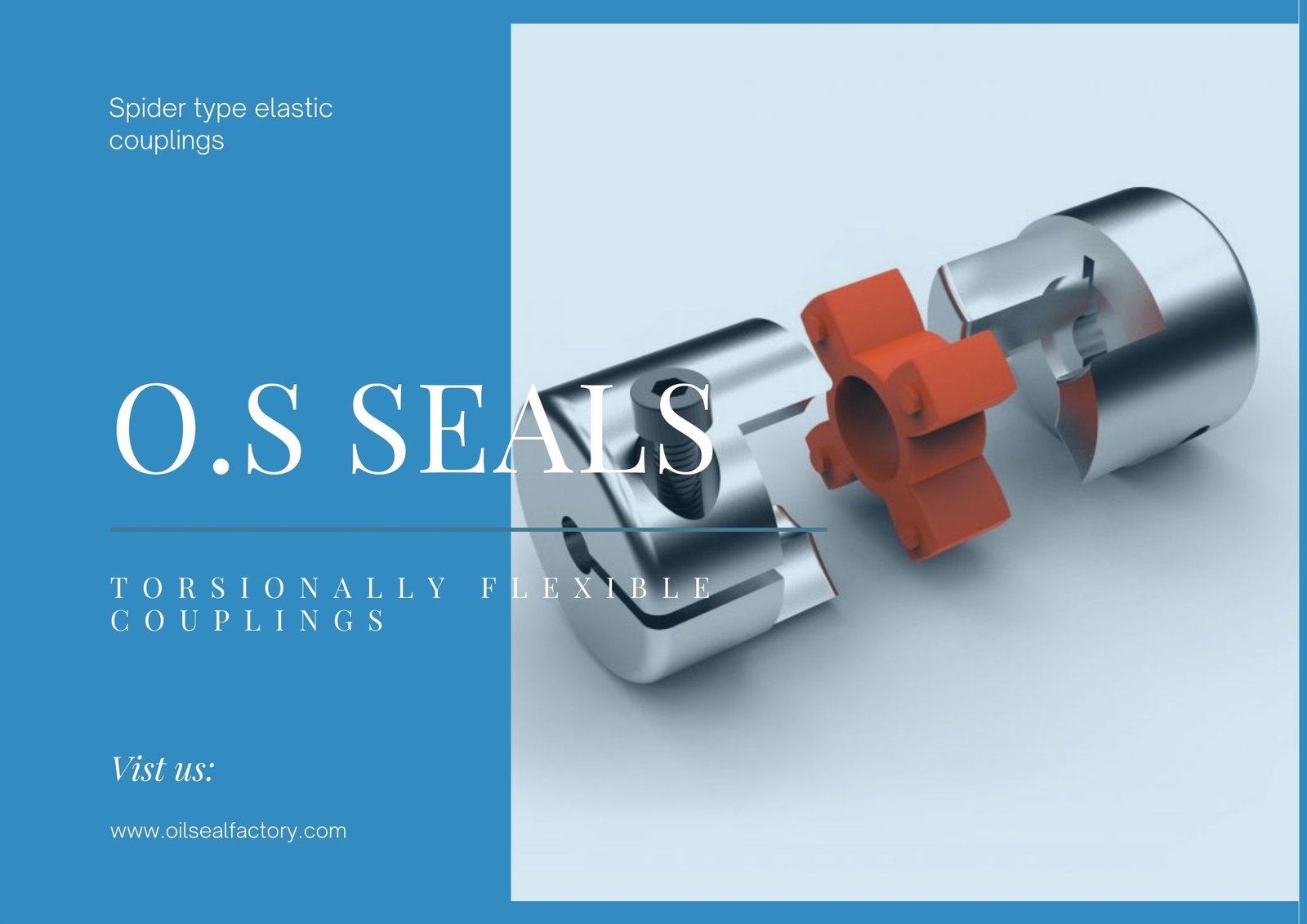
The jaw coupling is used in the middle of the coupling to play the role of shock absorption, insulation, buffer transmission torque. Different materials and different hardness of the jaw coupling are not the same, the higher the hardness, the greater of transmission torque is.
Material can be divided into polyurethane and rubber, nylon, etc.
Plummer elastic coupling has the following advantages compared with other couplings:
- large range of elastic modulus easy to obtain elastic elements of different stiffness
- Elastic coupling has low weight, high internal friction, good damping performance, more deformation energy stored per unit volume, no mechanical friction, and no lubrication required, etc. However, the metal material has low strength, small load-bearing capacity, poor resistance to high and low temperatures, easy to age and deteriorate, short service life and difficult to use. It is difficult to control the dynamic performance.
- Elastic coupling has low modulus of elasticity, large allowable deformation, and can obtain anisotropic elastic characteristics and complex geometry, so it is a material of non-metallic elastic elements with many applications.
Rubber has a large deformation energy per unit volume stored, good damping properties, and good insulation properties. The vulcanization method can make rubber and metal components. However, the strength of elastic coupling is low, the load-bearing capacity is small, the resistance to high and low temperatures and oil resistance is poor, it is easy to age, and the use and storage period is short.
What The Spider Actually Absorbs
The elastomer spider sits between the two hubs and takes three things out of the drive train: angular misalignment, parallel offset, and axial movement. It does this by deforming in shear rather than by sliding, which is why a jaw coupling needs no lubrication and why its stiffness is set by the compound rather than by metal-to-metal contact. The jaws transmit torque; the spider decides how much of the shock reaches the driven machine.
That division is why the same coupling body can be sold for a pump and for a crusher. Only the spider changes.
Choosing Spider Hardness
Hardness is the single choice that decides both torque capacity and damping, and the two move in opposite directions.
| Spider hardness | Torque it carries | Misalignment it tolerates | Typical use |
|---|---|---|---|
| 80 Shore A | Lowest of the three | Widest | Small pumps, fans, light drives with frequent starts |
| 92 Shore A | Medium | Medium | General machine drives, the usual default |
| 98 Shore A | Highest | Narrowest | Steady high torque with little shock |
The figures are typical for a given coupling size, not a rating. Confirm the torque against the coupling size and the service factor of the driven machine before ordering, because an oversized hard spider transmits shock that the gearbox was not designed for, and an undersized soft one turns into heat and dust.
Reading A Worn Spider
- Fine black dust around the jaws: the spider is running hot, usually from misalignment beyond its range
- Cracks starting at the inner corners of the lugs: fatigue from torque reversals or from a spider that is too hard
- Flattened, polished contact faces: the coupling is taking axial load it should not carry
- One side worn more than the other: parallel offset, or a hub that is not seated on its shaft
Replace the spider at the first sign of cracking rather than at failure. A failed spider lets the jaws run metal to metal, and the hubs are far more expensive than the insert. We produce spiders in polyurethane, rubber, and nylon for the coupling sizes on the jaw and spider coupling page, and can quote an insert alone if the hubs are still serviceable.
Questions We Get Asked
Can I fit a harder spider to carry more torque? Only within the coupling rating. The hubs and the shaft key set the limit, not the spider. A harder insert moves the shock into the hubs and the driven machine.
How often should the spider be replaced? Inspect at every service interval. In continuous duty with good alignment, two to three years is common; in shock-loaded drives it can be months.